Introduction
Facebook Lite allows you to save videos and reels to watch again later. However it does not offer a built-in way to save someone Video as a file on your phone. This missing feature is why people look for a video downloader, in the place. This guide explains the difference between saving and downloading, walks through a URL-based download workflow, and covers the format, quality, legal, and troubleshooting questions that come up most often — plus when Facebook’s own Save feature is simply the better choice.
Quick Answer
Facebook’s Save feature keeps a video in your account for later viewing but does not create a file on your device. To get an actual file, you generally need the video’s link and a compatible third-party downloader, and only for content you’re authorized to save — Facebook itself only lets you download reels you posted yourself, not other people’s videos.
Save vs. Download: They’re Not the Same Thing
| Option | What it does | Creates a local file? |
| Save video/reel on Facebook | Adds it to your Saved section for later viewing in-app | No |
| Facebook’s “download a reel you shared” tool | Lets you download reels you posted, to your own device | Yes, for your own content only |
| Third-party URL downloader | Attempts to convert an accessible video URL into a file | Potentially, depending on the video |
| Screen recording | Captures whatever plays on screen | Yes, but it’s a recording, not the source file |
Facebook’s Help Center confirms that reels and videos can be saved to a Saved section for later viewing, and separately that people can download reels they themselves shared to Facebook — with download options differing for content posted before and after September 2025. Facebook does not publish an equivalent tool for downloading videos that other people posted.
That last point is important: if the video does not belong to you and you do not have permission, from the person who posted it using a downloader is going beyond what Facebook officially offers, which is a big difference compared to using a built-in tool.
When to Use Facebook’s Save Feature Instead
Choose Save when:
- You only want to find the video again later, not keep an offline copy
- You don’t need the file outside the Facebook app
- You don’t have the rights or permission to make a separate copy
- You want to avoid using device storage
Choose a download when:
- You’re the one who posted the video
- The creator has given you clear permission
- The content is public domain or explicitly licensed for downloading
- You need an offline copy for a lawful, permitted purpose
How to Download a Video From Facebook Lite
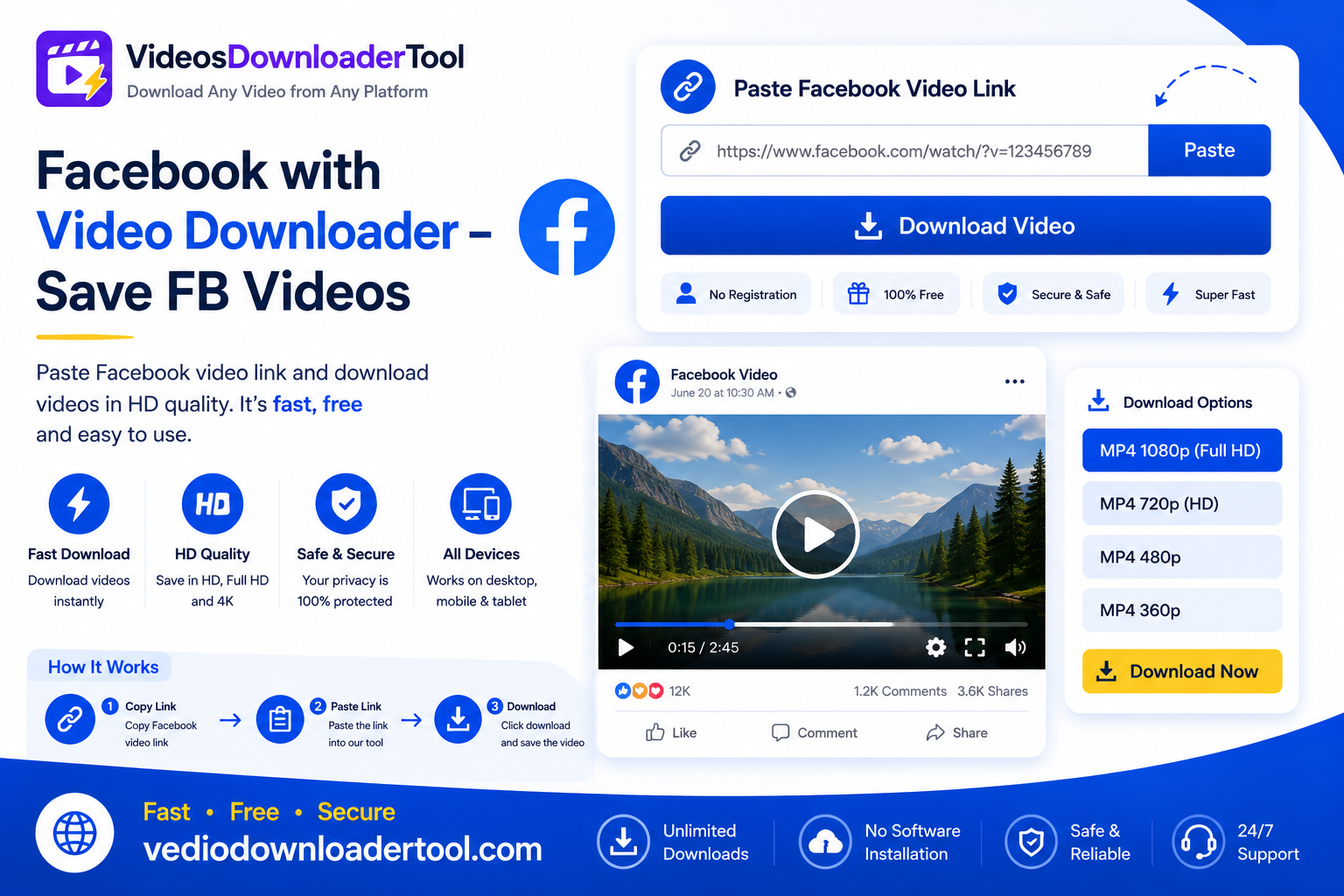
This is the general URL-based workflow. It only works for videos you’re authorized to download, and results depend on the video’s privacy settings and the downloader’s compatibility with the link.
- Open Facebook Lite on your Android device and find the video.
- Open the video and confirm it’s the correct post and one you have permission to save.
- Get the video’s link using Facebook’s share or link option (the exact menu wording can vary by app version).
- Open a mobile browser and go to the relevant page on VediosDownloaderTool.
- Paste the URL into the tool’s input field.
- Review whatever options appear — format and quality availability depends on the source video, not the downloader.
- Save the file, if the download completes, to your device’s Downloads folder or wherever your browser stores files.
Not every link will work. A tool can only process what the source video actually makes accessible.
Facebook Videos vs. Reels
Facebook has been consolidating video content into its Reels experience — its Help Center notes the Videos tab was renamed to Reels in June 2025. In practice, this means a link you’re trying to download might be labeled “video,” “reel,” or just “Reel” depending on when and how it was posted, even though the underlying process is similar.
Where Does the File Go on Android?
Location depends on your browser and device. Start with:
- The Downloads app or folder
- Your Files app, filtered by “Downloads” or “Recent”
- A browser-specific download folder (varies by Chrome, Samsung Internet, etc.)
Different manufacturers and Android versions organize this differently, so if you can’t find the file immediately, check your file manager’s recent files list rather than assuming one fixed path.
What About iPhone?
Facebook Lite is for people who use Android phones. If you have an iPhone you probably use the Facebook app or go to the Facebook website on your phone. To do something on Facebook Lite you have to get a link and open it in a browser like Safari. Then you use a tool to download the thing you want. After that you need to see if the file is in the Files app on your phone. Facebook Lite is not really, for iPhone users so they just use the Facebook app or a browser to do things.
Video Format: What to Expect
MP4 is the most broadly compatible option across phones, computers, and media players, when it’s available for a given video. Some tools or sources may expose other formats, but you shouldn’t assume every video can be downloaded in every format — availability depends on how the original was encoded and delivered.
Video Quality: What Actually Determines It
| Resolution | Typical use |
| 360p | Small file size, basic viewing |
| 480p | Standard-definition viewing |
| 720p | HD viewing |
| 1080p | Full HD viewing |
A downloader can’t manufacture detail that isn’t in the source. If a video was only ever delivered at 480p, no tool can turn it into a genuine 1080p file — it can only offer whatever streams the source actually provides. Be skeptical of any tool that claims guaranteed HD regardless of source quality.
Why a Download Might Fail
| Problem | Likely cause | What to try |
| Nothing happens after pasting the URL | Wrong link copied, or the page isn’t the actual video post | Re-copy the link directly from the video |
| “Video not found” or similar | Video is private or restricted to certain audiences | Only attempt content you’re authorized to access |
| Video was deleted | Post no longer exists | Confirm the post is still live before retrying |
| Works sometimes, not other times | Facebook changed link structure or delivery method | Try a freshly copied link later |
| Download starts but quality is poor | Source video itself is low-resolution | Check whether a higher-quality version exists at the source |
| Browser blocks the file | Download permissions or storage settings | Check browser settings and available storage |
Is It Safe to Use an Online Downloader?
Treat any downloader site with the same caution you’d apply to other websites:
- Never enter your Facebook password into a third-party site
- Avoid clicking unexpected pop-ups or “update” prompts
- Don’t install browser extensions or APKs a site claims are “required”
- Keep your browser updated
- Avoid handing over personal information that isn’t genuinely needed for the task
A browser-based tool that just processes a URL is generally lower-risk than installing unknown software, but that doesn’t make every website trustworthy — use judgment.
Is It Legal?
There’s no simple yes or no answer. In the United States people who own copyrights usually have the right to make copies and share their work. The United States Copyright Office says that fair use is looked at differently for each situation of following a set rule or number. Just because a video is visible, to everyone does not mean you are allowed to copy it or share it again.
Downloading is on firmer ground when:
- It’s your own video
- The creator gave explicit permission
- The content is public domain or licensed for that use
This isn’t legal advice — if you need certainty for a specific situation, consult a qualified professional.
Best Practices
- Confirm you have the right or permission to download the content before you start
- Use the actual video link, not a general post or profile URL
- Don’t expect every link, format, or resolution to work
- Prefer Facebook’s Save feature when you don’t actually need an offline file
- Keep your browser current and be cautious with unfamiliar sites
Conclusion
If you just want to find a video again later, Facebook Lite’s built-in Save feature already does that without creating a file. An actual downloaded copy makes sense only when you’re the creator, have clear permission, or the content is licensed for that use — Facebook itself only offers a download tool for reels you posted, not other people’s videos. When you do have an accessible, authorized video link, a browser-based tool such as VediosDownloaderTool can process the URL, though the available format and quality will always depend on the source video, not the tool.
FAQs
You can try to do this by using the video link and a browser that can download videos.. It will only work if the video is not private and if Facebook lets you save it. If you just want to watch the video you can use Facebooks Save feature. It is a lot easier to use Facebooks Save feature to find the video. You can try with the Facebook video. See if it works. Facebook video download is not always possible. You can use Facebooks Save feature, for the Facebook video.
Open the video and use the share or link option in the post’s menu. The exact wording can differ slightly by app version.
Yes. Facebook’s Save feature adds the video or reel to your Saved section for later viewing inside the app, without creating a separate file on your device.
No — private or audience-restricted videos generally aren’t accessible to third-party tools, and trying to work around that isn’t appropriate. Only download content you’re authorized to access.
Yes. Facebook provides a feature specifically for downloading reels you’ve posted yourself, with options that differ for content shared before and after September 2025. This is separate from downloading other people’s videos.
Usually the Downloads folder, though the exact location depends on your browser and device manufacturer. Check your file manager’s recent files if you can’t find it right away.